
The obvious options trade this week is to sell earnings premium.
Home Depot reports Tuesday morning. Lowe’s reports Wednesday morning. Alibaba and Ross Stores report Thursday.
Their option chains are offering exactly what traders expect before a binary event: elevated implied volatility, rapid time decay, and the possibility of collecting several days of premium in one trade.
I am passing.
Last week’s journal showed why. I realized $2,452, but the covered-call legs I opened or rolled still moved approximately $3,102 against me. The premium was visible immediately. The obligation behind it became visible later.
This week I want the opposite setup: simple covered calls against shares I already own and cash-secured puts at prices where I would genuinely accept assignment. No spreads. No condors. No short option held through an earnings announcement.
The screen produced six candidates with approximately $471 of modeled gross premium. But the real number is not $471. It is the $51,923 of stock and cash obligation supporting those trades.
That ratio is the entire point of this article.
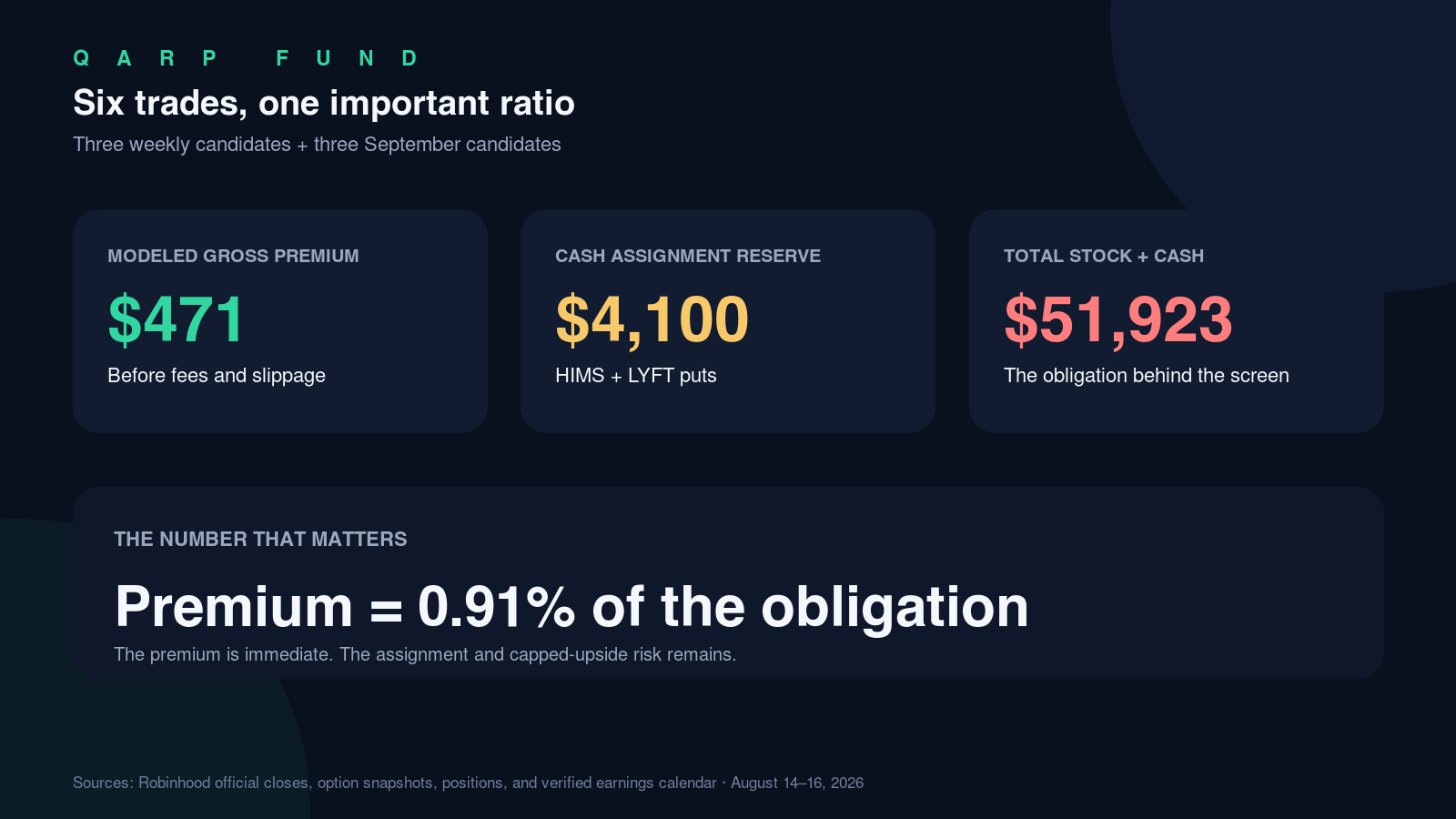
These are research candidates, not orders. Quotes are from the August 14 close and must be repriced after Monday’s open.
The six-trade screen
I split the list into three positions expiring Friday and three expiring September 18.
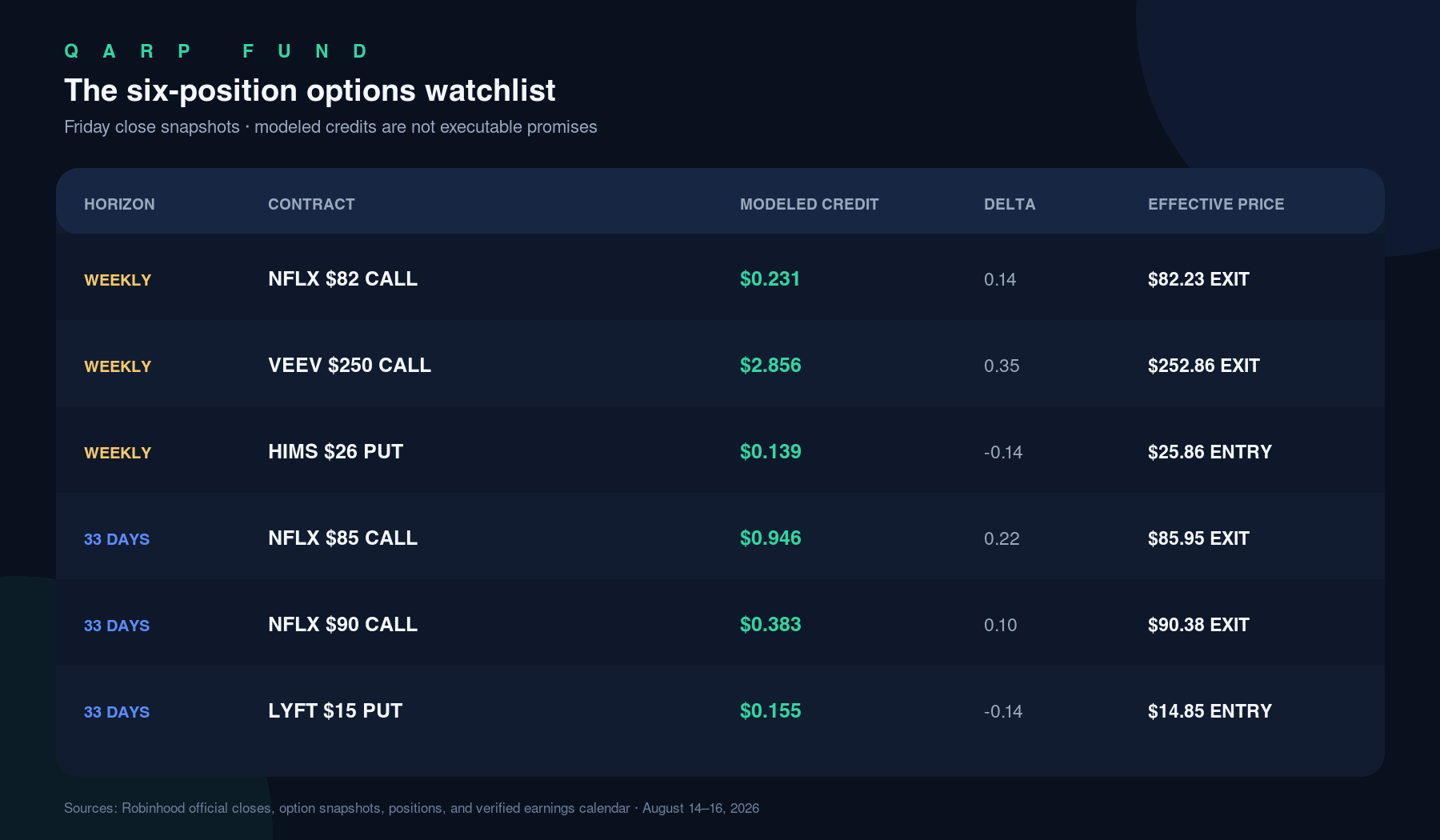
The list is deliberately uneven. NFLX has clean markets. VEEV and LYFT do not. One candidate offers $286 of modeled premium; another offers only $14.
I do not expect all six to qualify on Monday.
The goal is not to complete a checklist. The goal is to let price, liquidity, and assignment math eliminate the weak trades.
My highest-conviction structure is the NFLX ladder
I own 300 Netflix shares at an average cost of $79.92. Instead of selling three identical calls, I am considering one contract at each of three different exit levels:
One August 21 $82 call for approximately $0.231
One September 18 $85 call for approximately $0.946
One September 18 $90 call for approximately $0.383
Netflix’s official August 14 close was $78.16.
The weekly $82 call prioritizes immediate decay. Its market was $0.23 by $0.24, with more than 7,000 contracts of both volume and open interest. The effective exit would be approximately $82.23.
The September $85 call balances income and upside. Its market was $0.94 by $0.98, and the effective exit would be approximately $85.95.
The September $90 call pays less, but preserves more upside. Its market was $0.38 by $0.40, and the effective exit would be approximately $90.38.
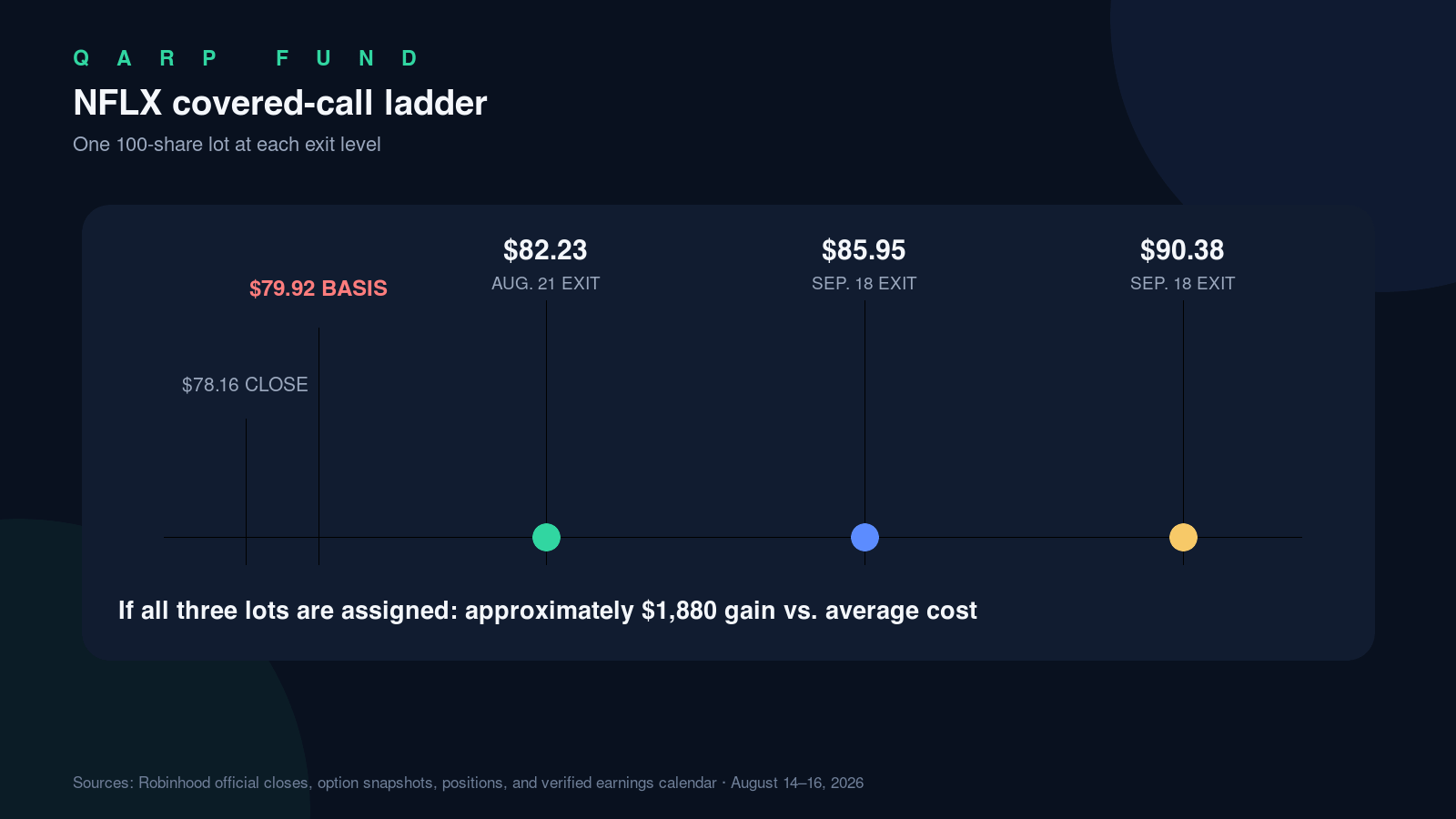
If all 300 shares were called away, the estimated combined gain versus my average cost, including the modeled option credits, would be approximately $1,880.
That sounds attractive. The risk is equally clear: a strong NFLX rally would cap the upside on every share.
Netflix reported in July. Its next earnings date is tentatively October 20, after both candidate expirations.
My minimum credits: $0.20 for the $82 call, $0.90 for the $85 call, and $0.35 for the $90 call.
VEEV offers the most premium and the least trustworthy quote
Veeva’s official August 14 close was $243.75. I own 100 shares at an average cost of $187.76.
The August 21 $250 call showed:
Bid: $1.90
Ask: $4.60
Modeled sell fill: approximately $2.856
Delta: approximately 0.35
Effective exit: approximately $252.86
At the modeled fill, the call would generate about $285.60. If assigned, the estimated stock gain plus premium would be approximately $6,510 relative to my average cost.
Veeva reports on August 26, five days after the option expires. That lets me sell a short-dated call without carrying it through the earnings release.
But the $2.70 bid-ask spread is the warning. A midpoint is not money. The modeled $2.856 credit is not executable until a buyer actually fills it.
This is a patient limit-order candidate only. If the spread remains wider than $1 or the market will not pay at least $2.75, I will skip it.
HIMS is a small premium attached to a volatile obligation
Hims & Hers closed at $28.15. The August 21 $26 put was $0.13 by $0.17, with a modeled sell fill near $0.139.
That produces only $13.90 of modeled premium against $2,600 of assignment cash.
The effective purchase price would be approximately $25.86, or 8.1% below the official close.
HIMS reported earnings on August 10, so the option does not cross the next report. The result was weak: EPS was -$0.37 versus a -$0.05 estimate.
That is why a low delta is not enough. A -0.14 delta does not make the business risk disappear, and $14 is not meaningful compensation for owning 100 unwanted shares.
I would sell this put only if I genuinely want HIMS near $25.86. If the stock opens below $27.50, the original setup has changed and I will reassess.
My minimum credit: $0.13.
LYFT offers a better discount, but poor liquidity
Lyft’s official August 14 close was $17.48. The September 18 $15 put was quoted at $0.10 by $0.32, with a modeled sell fill near $0.155.
That creates:
Approximately $15.50 of modeled premium
$1,500 of assignment cash
An effective purchase price near $14.85
A 15.1% discount to the official close
A short-put delta near -0.14
Lyft reported on August 6 and its next earnings date is tentatively November 4, after the option expires. The latest EPS result was $0.13 versus a $0.15 estimate.
The setup is simple. The market is not. The option traded only 34 contracts on Friday and displayed a $0.22 spread.
I will require at least $0.15 and use a limit order. If Lyft opens below $17, I will reassess rather than automatically selling the same strike.
The premium looks different beside the obligation
The four covered calls reserve:
300 NFLX shares worth $23,448 at the official close
100 VEEV shares worth $24,375 at the official close
The two cash-secured puts reserve:
$2,600 for HIMS assignment
$1,500 for LYFT assignment
That is $47,823 of stock plus $4,100 of cash, or $51,923 supporting the screen.
The modeled premium is $471, before fees and slippage. That is about 0.91% of the stock and cash obligation.
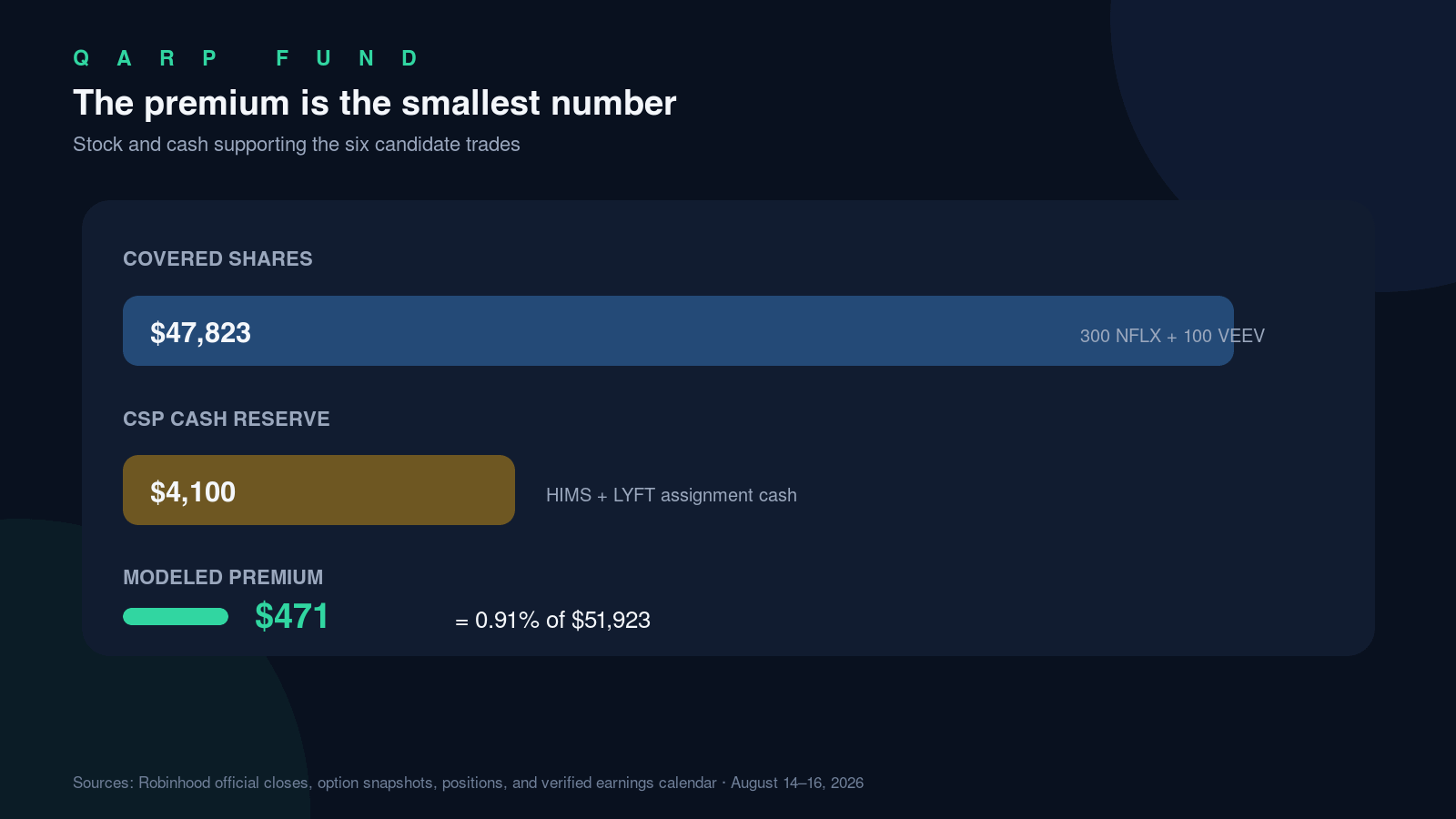
This does not make the trades bad. It makes the sizing visible.
The covered-call premium is payment for limiting upside on shares I already own. The put premium is payment for committing to buy shares after a decline. Neither is free income.
Why I am skipping the earnings premium
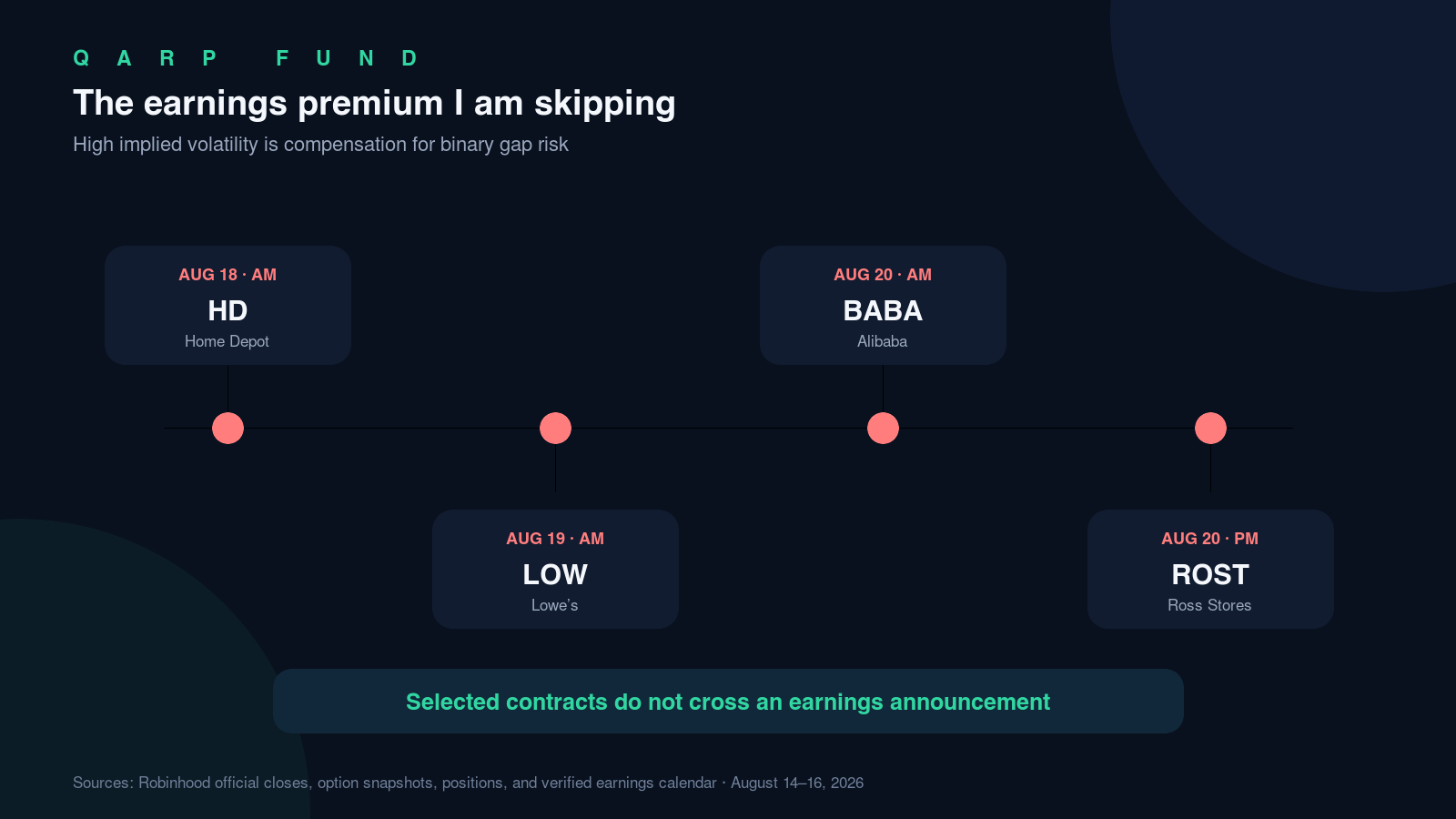
The week’s obvious high-volatility events are:
Home Depot: August 18 before the open
Lowe’s: August 19 before the open
Alibaba: August 20 before the open
Ross Stores: August 20 after the close
I am passing for three reasons.
First, an earnings move is discontinuous. A stock can gap through several strikes before the market opens, leaving no opportunity to adjust.
Second, elevated premium is not an edge by itself. It is the market’s price for accepting elevated uncertainty.
Third, last week already left me with meaningful stock, covered-call, and short-put exposure. I do not need a new binary event merely because the annualized premium looks attractive.
Sometimes the best premium trade is the one that preserves capital for the next week.
My ranking for Monday
Based on Friday’s markets, my order of preference is:
NFLX September 18 $85 covered call
NFLX August 21 $82 covered call
NFLX September 18 $90 covered call
HIMS August 21 $26 cash-secured put
VEEV August 21 $250 covered call
LYFT September 18 $15 cash-secured put
VEEV ranks fifth despite offering most of the premium because its displayed market is too wide. LYFT ranks last because the premium is small, volume is low, and the spread is large.
That ranking can change after one clean Monday quote.
The Monday rules
Wait 15-30 minutes after the open before trusting option markets.
Use limit orders only.
Reprice every contract; Friday’s quotes are not promises.
Do not lower minimum credits just to force fills.
Keep call quantities within shares already owned.
Sell puts only at prices where assignment is an acceptable stock purchase.
Trade fewer than six positions if only the clean markets qualify.
The highest premium is not always the best trade.
The better question is: What obligation am I accepting, and would I still want it if the premium were half as large?
Disclosure: I own shares of NFLX and VEEV. This article documents my personal research process and is not investment advice. Options involve risk, including assignment, capped upside, and loss of principal. Equity prices are official August 14, 2026 closes. Option quotes are Robinhood snapshots from the August 14 close and may change materially before an order can be entered. No candidate order was reviewed or placed.