
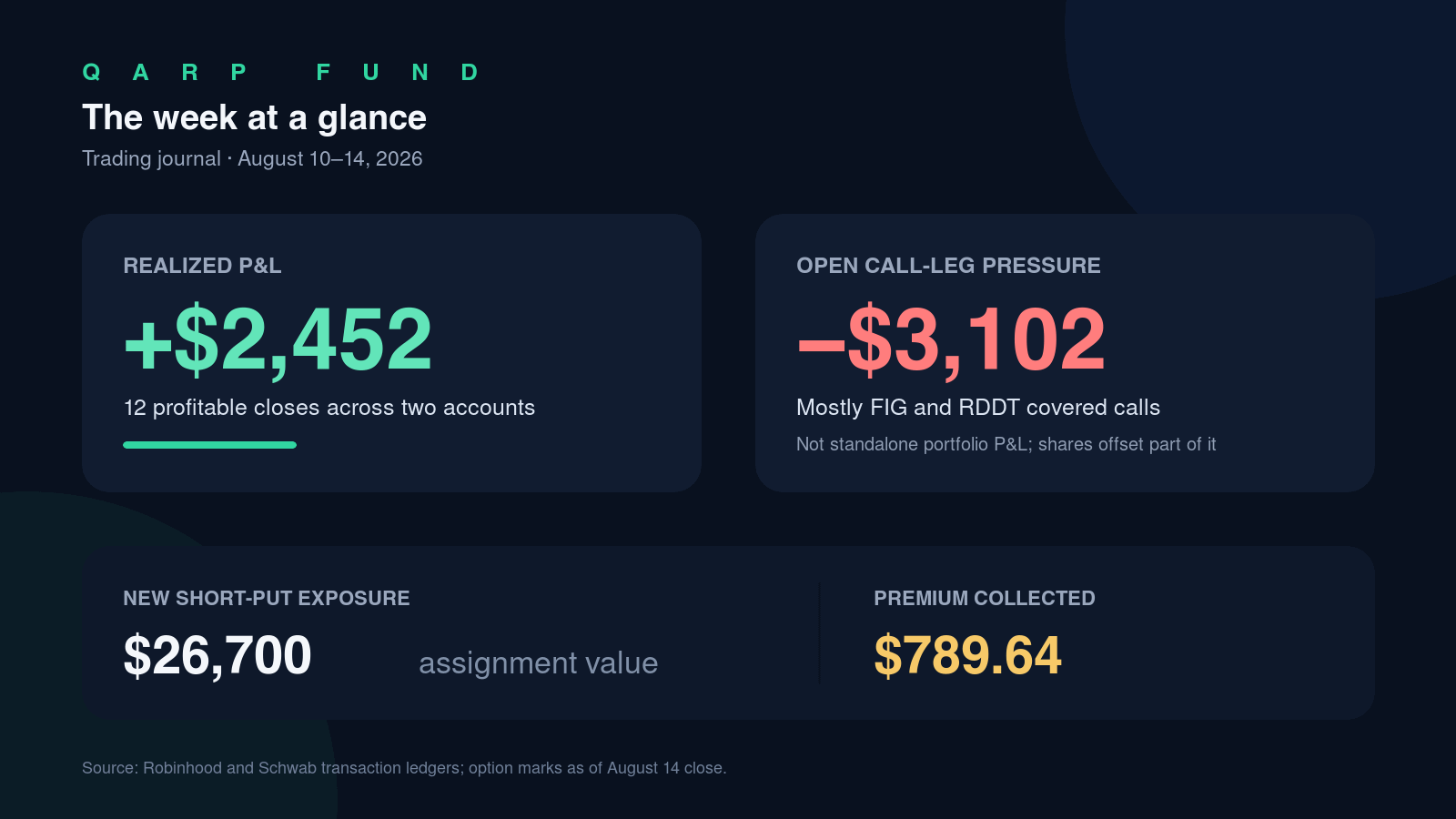
By Friday, my brokerage ledgers showed $2,452.13 of realized profit for the week.
That is the attractive headline. It is also incomplete.
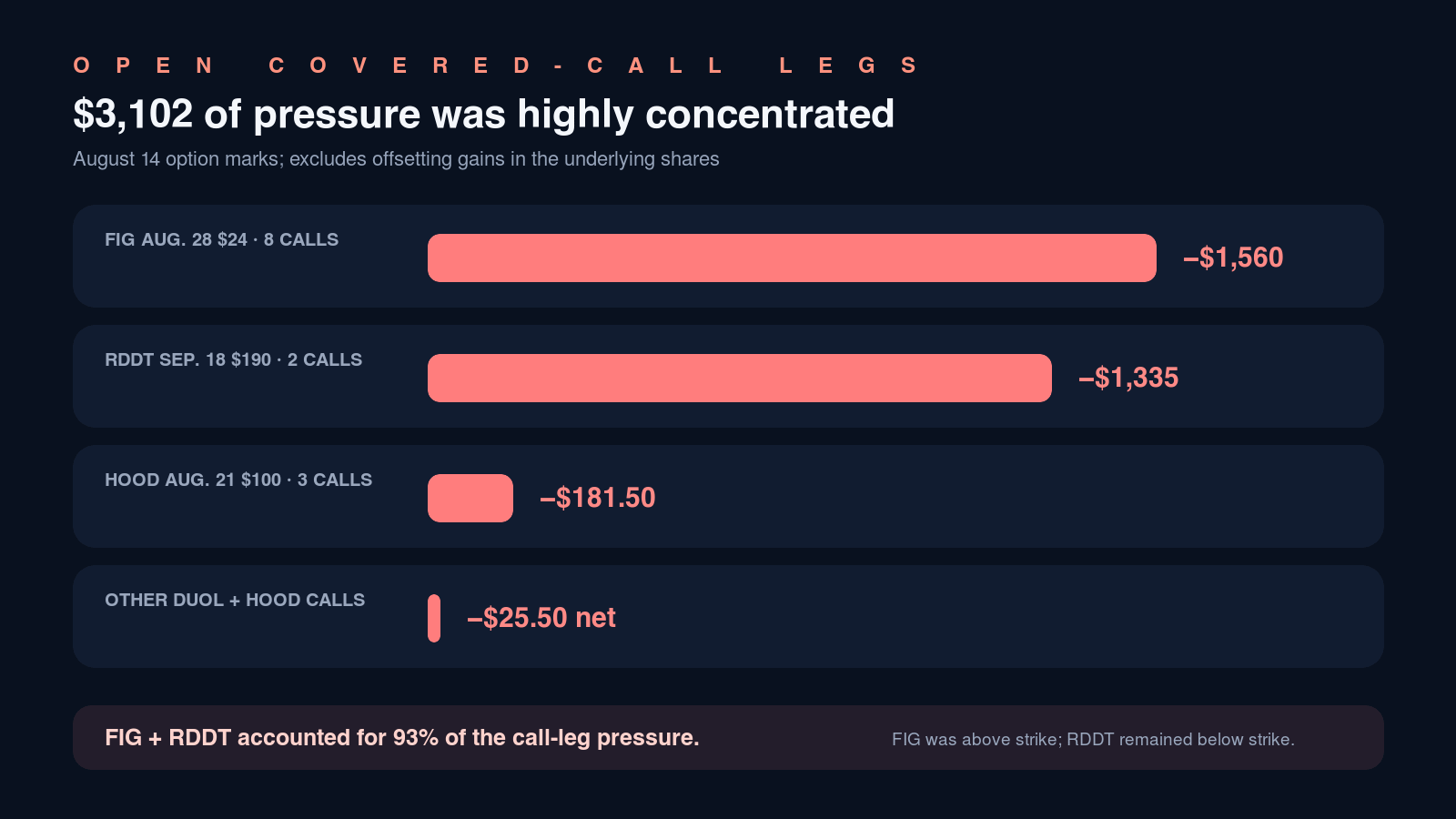
The covered-call positions I opened or rolled during the same week were marked approximately $3,102 against me by Friday’s close. That does not mean the portfolio lost $3,102: the calls were covered by stocks that had appreciated. It means I had sold away some of that upside, and the option side of the trade was now showing the bill.
This was a profitable week. It was not a risk-free one, and it definitely was not a clean example of “passive income.”
Here is the complete journal.
This is a record of my own trades, not investment advice. Option marks can be noisy, especially when spreads are wide.
The scoreboard
Across Robinhood and Schwab, I realized:
The trade-level breakdown was:
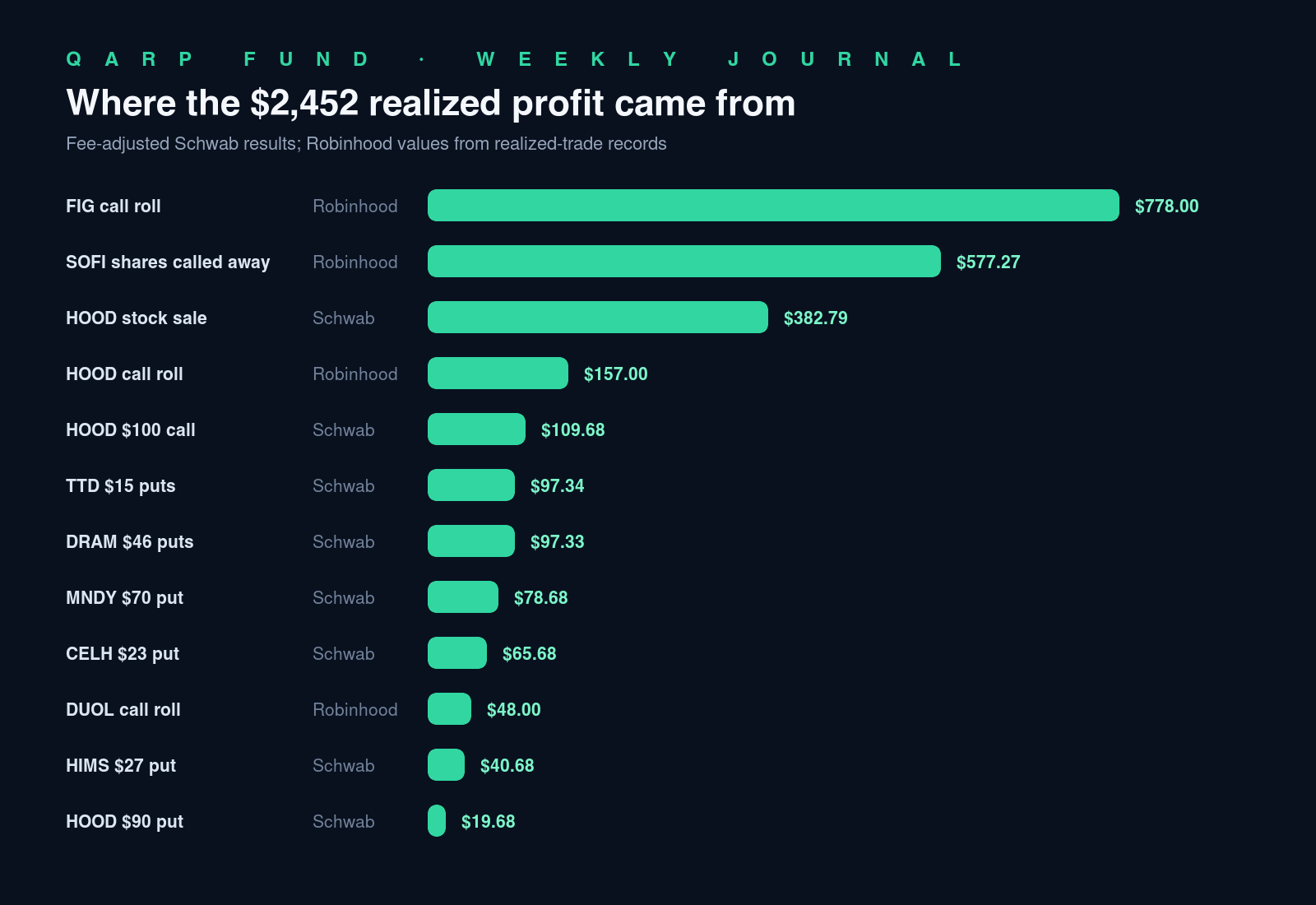
The SOFI result was assignment-driven, not a discretionary stock sale. Five August 14 $18 covered calls were assigned, so 500 shares were called away at expiration. The $577.27 above is the realized stock result recorded by Robinhood for that event.
Every closed trade in this set was profitable. That sounds great, but a list of winners can still conceal weak decisions. Realized P&L only records what has ended. It says nothing about the risk that remains open or the upside I have capped.
The assignment that became a covered call
The most instructive trade was TTD.
I had sold four August 7 $15 puts for $97.34 after fees. The stock finished below the strike, so I was assigned 400 shares at $15, committing $6,000.
Assignment is often described as if it is automatically a failure. I do not think that is useful. The better question is whether I was genuinely willing to own the shares at the effective price.
After including the put premium, my effective basis was approximately $14.76 per share.
On Monday, I sold four September 11 $14.50 covered calls for another $197.34 after fees. If the shares are called away at $14.50, the put and call premiums are enough to make the entire sequence modestly profitable despite the lower exit strike.
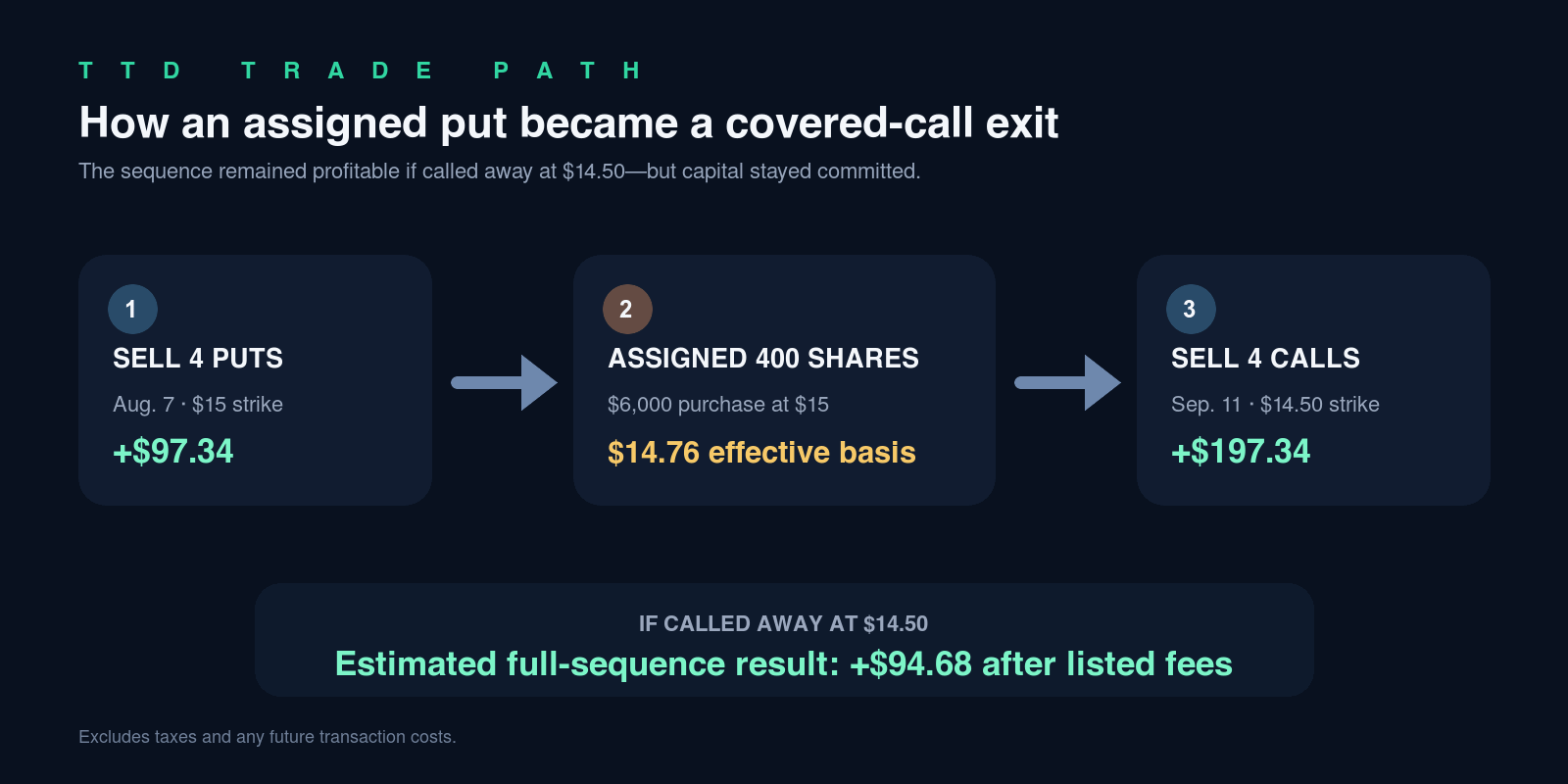
That is the good version of the wheel: accept shares at a planned price, lower the basis, and sell a call at an exit that still produces an acceptable result.
The danger is pretending assignment does not use capital. At Friday’s close, the TTD shares were still showing an unrealized loss, while the covered calls had also moved against me. Combined, the new TTD stock-and-call position was approximately $315 underwater before including the original put premium.
The trade still had a path to a profit. It was not free money.
I closed HOOD, then immediately sold more HOOD risk
HOOD produced my best Schwab sequence of the week.
I bought 100 shares on August 4 at $90.25 and had sold an August 14 $100 covered call. On Monday I:
Bought the call back for a $109.68 profit.
Sold the shares at $94.08 for a $382.79 profit after fees.
That closed the stock-and-call sequence for $492.47.
Then I sold an August 21 $90 put for $226.34. One day later, I bought it back for $206.66, realizing only $19.68.
The small profit was less important than the decision to reduce risk. I replaced it with a September 18 $85 put for $329.33, moving the strike $5 lower and giving the trade more time.
This is where a weekly journal is more revealing than a screenshot of closed profits. I did not simply “win” on HOOD. I took profits in one structure, briefly reopened aggressive exposure, then adjusted to a lower strike.
Three rolls generated profit, but did not eliminate the obligation
In Robinhood, I rolled covered calls in FIG, HOOD, and DUOL.
The closing legs realized:
FIG: +$778
HOOD: +$157
DUOL: +$48
The replacement orders also brought in net credits:
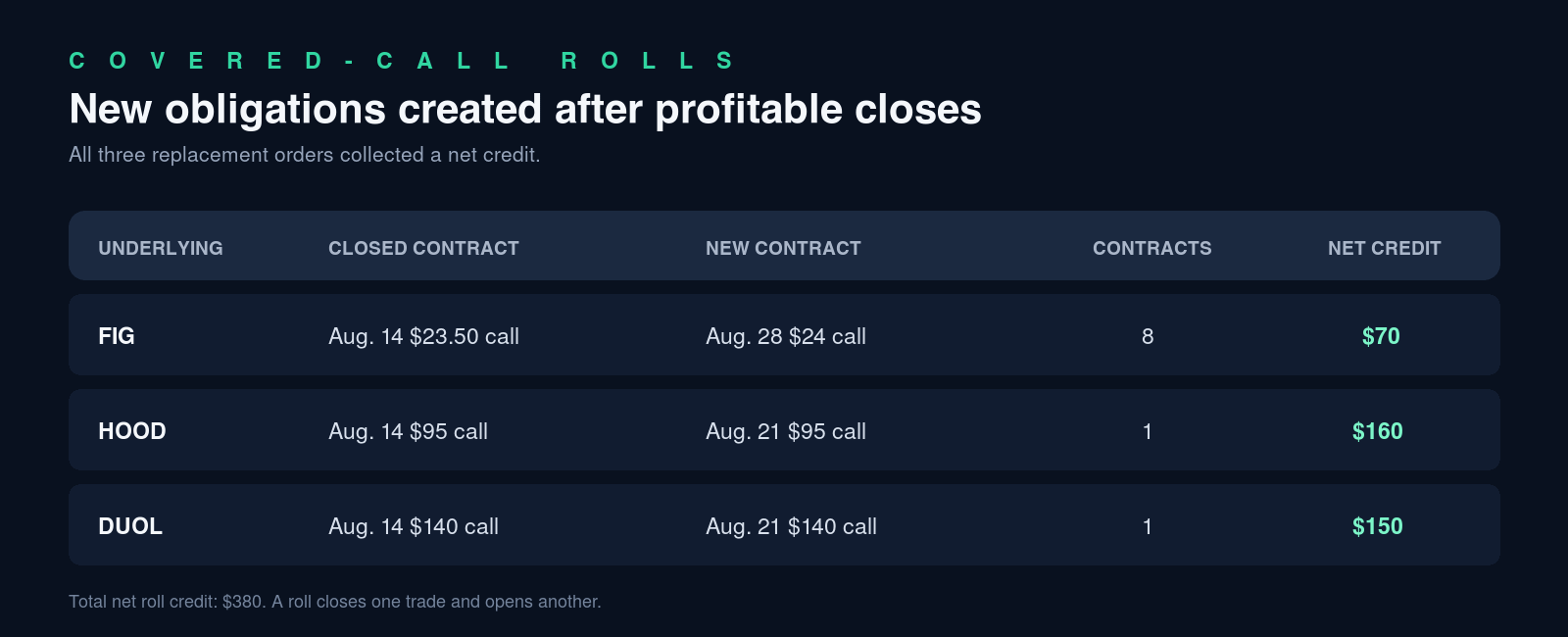
It is tempting to treat the $983 of realized profit and $380 of roll credits as a completed success.
But a roll is not an escape. It is a close and a new trade.
By Friday, the eight new FIG $24 calls were marked approximately $1,560 against me. FIG’s official August 14 close was $25.42, above the new strike. The roll bought two weeks and raised the strike by only $0.50.
That may still be acceptable if I am happy to sell 800 shares at $24. It is a poor trade if I am emotionally attached to keeping the shares.
The same question applies to every covered call: Would I actually sell the stock at the strike today?
If the answer is no, the premium is not compensation. It is bait.
The most surprising open loss was RDDT
I also sold two September 18 RDDT $190 calls for $330.
RDDT’s official August 14 close was $178.09, below the $190 strike, while the calls were marked near $8.33. The option legs were approximately $1,335 underwater.
That distinction matters. The option loss was not intrinsic value from RDDT already trading through the strike. It reflected the contract’s remaining time value and repricing. It is also not standalone portfolio P&L because the calls are covered by shares.
This is another version of the premium trap. A $330 credit feels fixed when it arrives, but the cost to close can expand even while the stock remains below the strike.
If RDDT later trades above $190, the calls will cap upside. At the August 14 close, however, the immediate issue was expensive optionality rather than an in-the-money call.
The new short puts carried more risk than the premiums suggested
In Schwab, I opened or retained several short puts:
Two September 18 DRAM $43 puts
One September 18 HOOD $85 put
Two September 18 PINS $21 puts
Three August 21 SOFI $18 puts
Together, those contracts represented $26,700 of assignment value.
The premiums were much smaller:
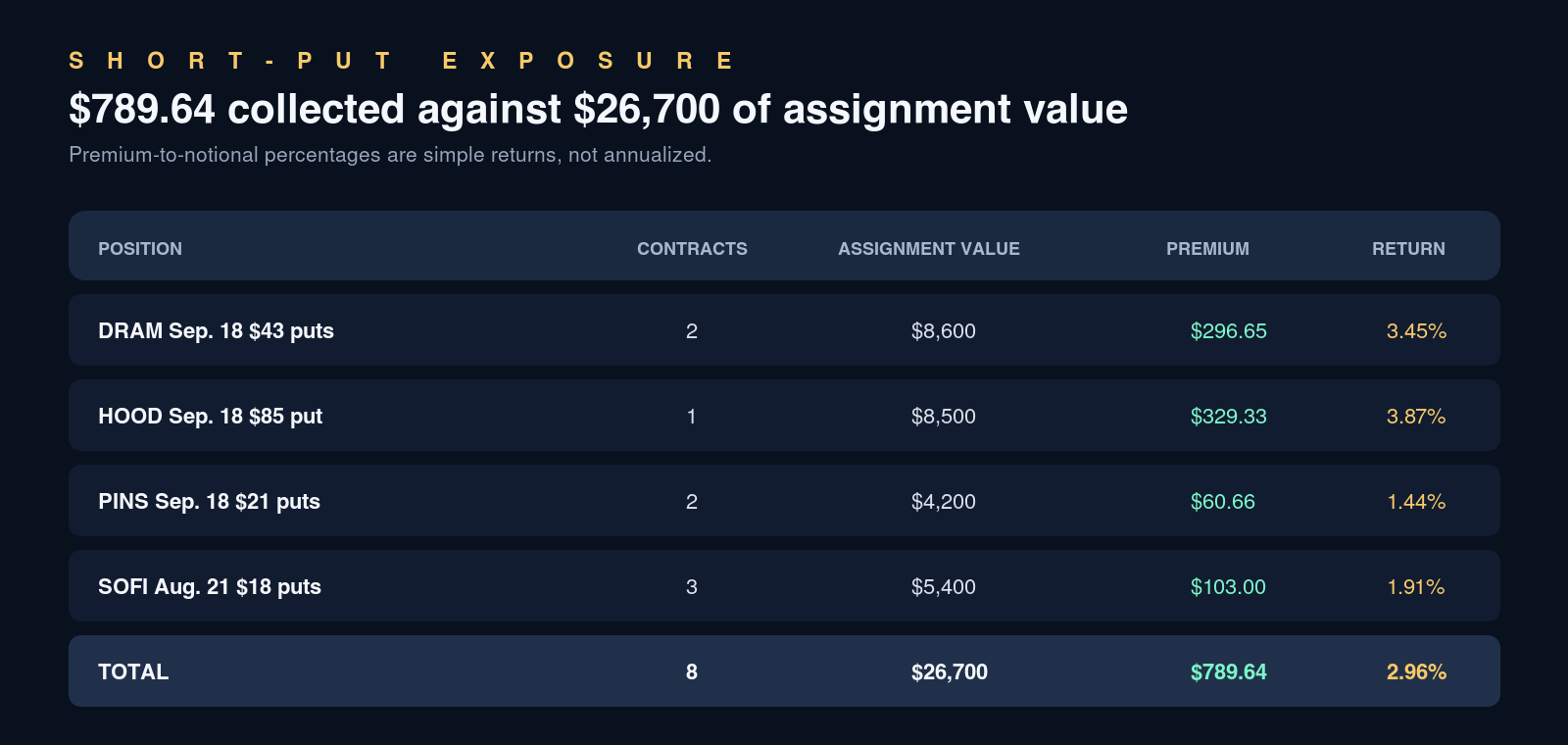
That is $789.64 collected against $26,700 of possible stock purchases. The percentages are simple premium-to-strike-notional figures, not annualized returns.
This is the number I need to focus on. The premium is the visible reward; the assignment value is the real position size.
At the account level, these puts were not all fully cash secured. Margin was supporting part of the exposure. That changes the risk materially. A collection of individually reasonable trades can become one leveraged trade when the same market decline pressures all of them at once.
I also bought 200 NFLX shares
One transaction had no premium attached: I bought 200 NFLX shares at a weighted average price of approximately $75.49, committing about $15,099.
Those shares can eventually support covered calls, but I do not want the existence of 200-share lots to force a trade. The call still needs an acceptable strike, enough premium, and a price where I am willing to exit the stock.
The inventory is not an instruction to sell calls immediately.
What actually worked
Three things worked well:
First, closing profitable short options early. CELH, MNDY, HIMS, DRAM, and the short-lived HOOD put all returned capital without waiting for expiration.
Second, accepting assignment with a plan. TTD was not pleasant, but the put premium, adjusted basis, and covered-call exit were all measurable.
Third, moving risk out in time and down in strike. The HOOD put adjustment from $90 in August to $85 in September improved the entry level rather than defending the original strike out of pride.
What did not work
The weak point was covered-call risk management and interpreting option-leg P&L without enough underlying-price context.
The Robinhood calls opened or rolled during the week were marked approximately $3,102 against me at Friday’s close. About $2,895 of that came from FIG and RDDT alone.
FIG had already crossed its strike. RDDT had not. Grouping both losses under the same “capped upside” explanation was inaccurate even though the combined option-leg mark was correct.
The second weakness was aggregate put exposure. Looking at each premium separately made the trades appear small. Looking at the $26,700 assignment value revealed the real commitment.
The lesson I am carrying into next week
My realized result was +$2,452.13. I am happy with it.
But the number I want to remember is not the profit. It is the $3,102 of pressure on the covered-call legs and the $26,700 of short-put assignment value.
Those figures explain what the closed-trade total cannot:
Covered calls exchange upside for immediate cash.
Rolling realizes one result while creating another obligation.
Short-put premium is small relative to assignment capital.
Assignment is manageable only when it was planned before entry.
Premium selling works best for me when it supports a stock decision I already want to make: buy at this price, or sell at that price.
When the premium becomes the reason for the trade, the strategy starts managing me.