
Fair Isaac has delivered the combination investors usually pay almost any price to own:
A product embedded in the financial system
Extraordinary pricing power
Very little capital intensity
Expanding margins
Aggressive share repurchases
For years, the problem was not the business. It was the valuation.
That has changed.
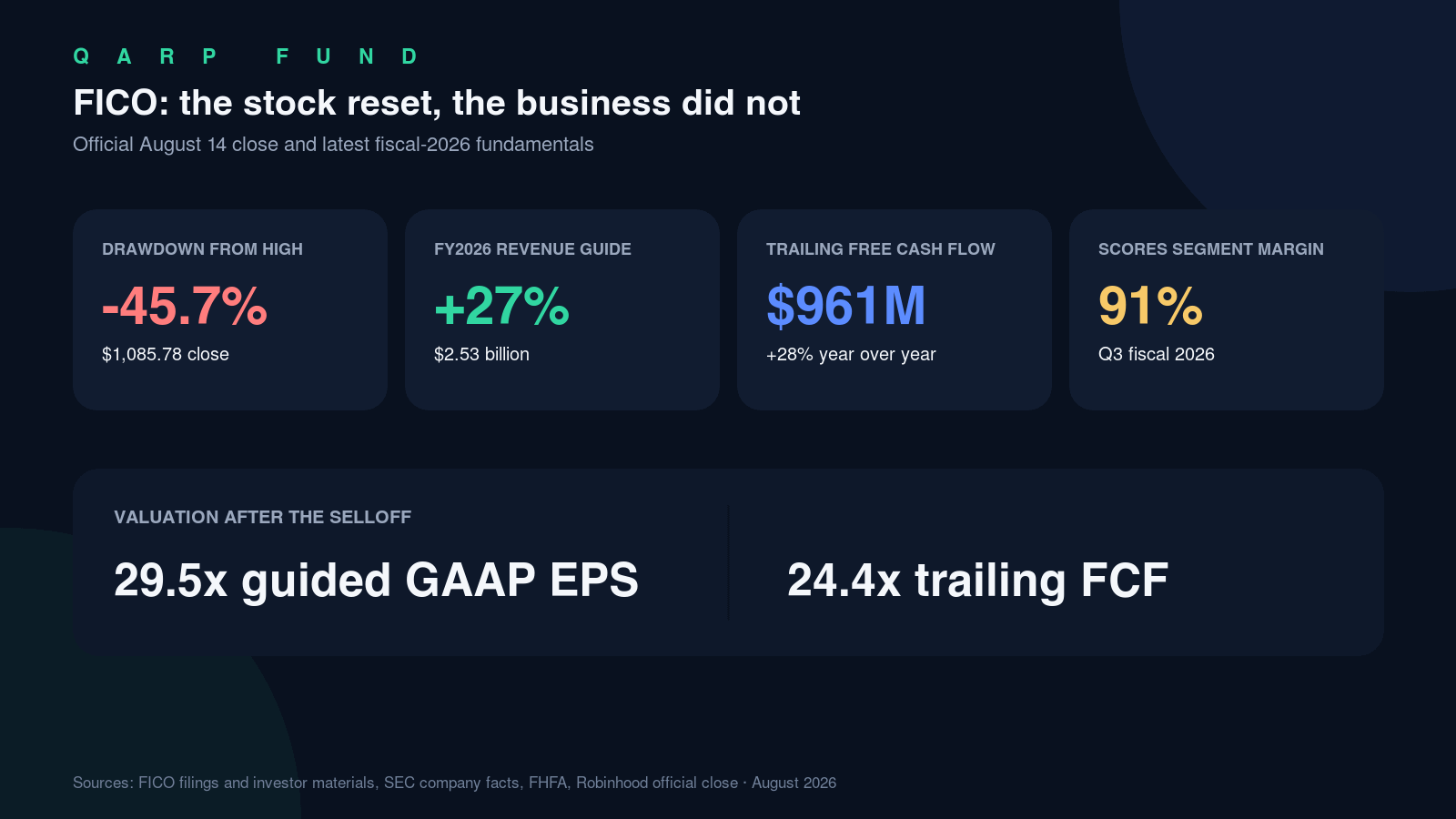
FICO closed August 14 at $1,085.78, down 45.7% from its 52-week high of $1,998.01. Yet the company just reported 26% quarterly revenue growth, raised fiscal-2026 revenue guidance to $2.53 billion, and produced $961 million of trailing free cash flow.
The selloff has brought the stock to approximately 29.5x guided GAAP earnings and 24.4x trailing free cash flow.
That is not a traditional value-stock multiple. It is a much more interesting price for one of the highest-quality businesses in financial data.
The question is whether the market is offering a rare entry point or correctly discounting a new era of mortgage-score competition, regulatory pressure, and debt-funded buybacks.
This is company research, not investment advice. Financial figures are from FICO’s filings and investor materials. The stock price is the official August 14, 2026 close.
FICO is really two businesses
FICO operates two segments: Scores and Software.
The Scores business owns the familiar consumer credit-risk models used across mortgages, auto loans, credit cards, and personal loans. FICO says its score is used by 90% of top U.S. lenders.
The Software business sells analytics, fraud tools, decisioning systems, and the cloud-based FICO Platform to enterprises.
They have very different economics.
In the latest quarter, Scores generated $458.9 million, or 68% of total revenue, at a 91% segment operating margin.
Software generated $215.3 million at a 26% segment margin.
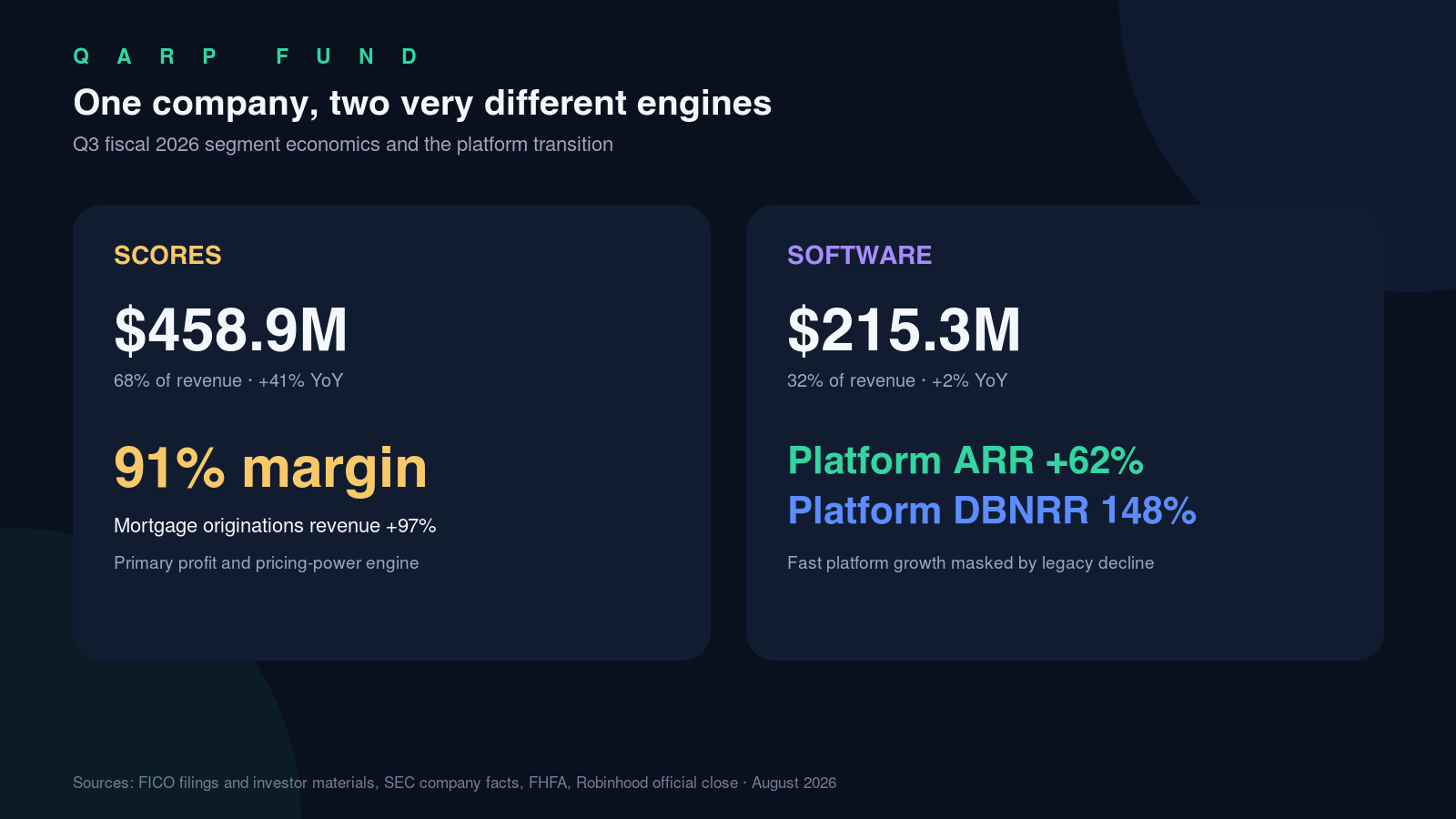
Scores is the profit engine. Software is the second growth option.
That distinction matters because the investment case depends on both:
Scores must preserve its pricing power as mortgage competition increases.
FICO Platform must eventually turn rapid cloud growth into faster total Software growth.
The financial compounding is exceptional
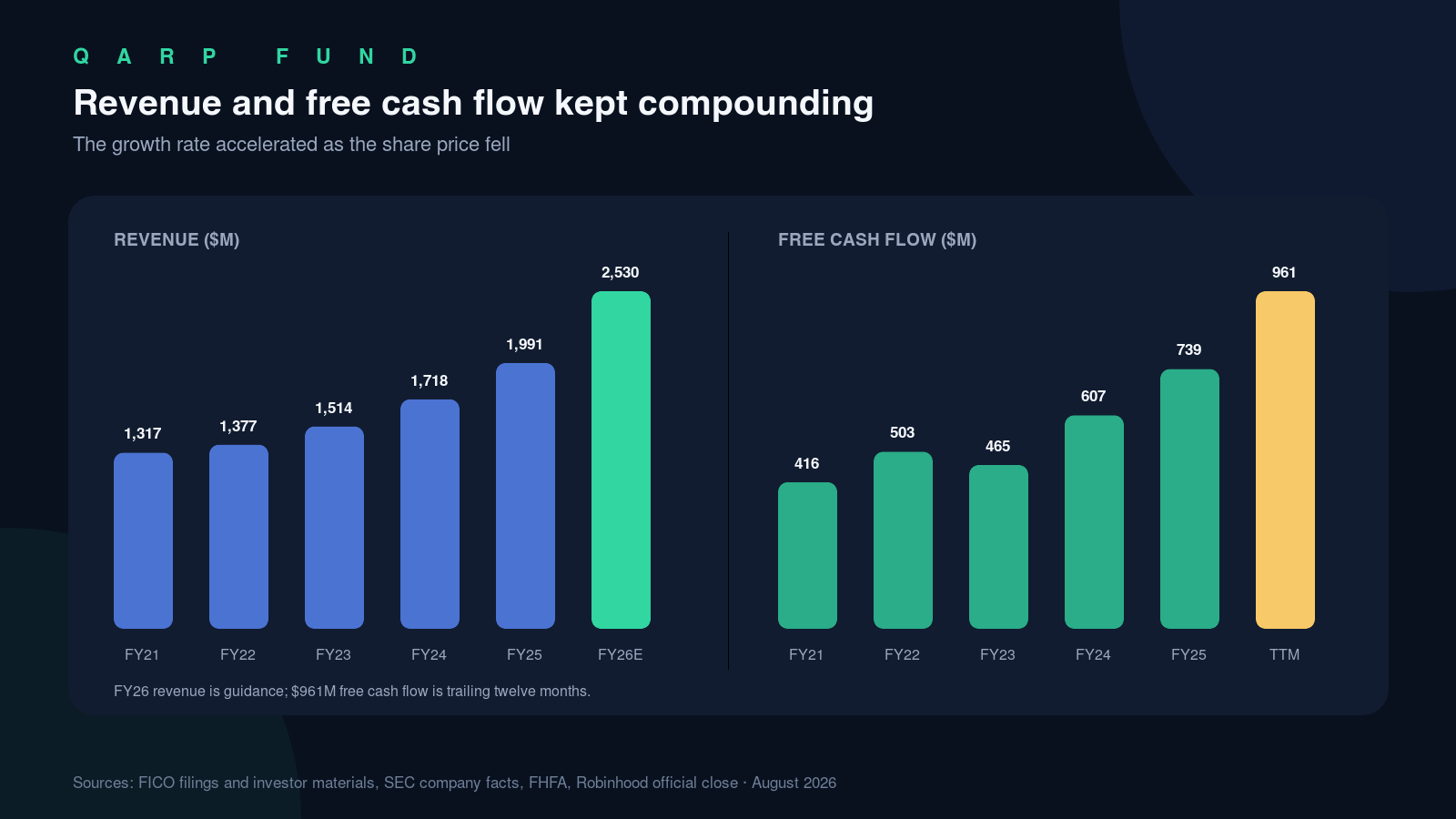
FICO’s revenue increased from $1.32 billion in fiscal 2021 to $1.99 billion in fiscal 2025, a 10.9% compound annual growth rate.
Updated fiscal-2026 guidance calls for $2.53 billion, which would be approximately 27% growth in one year.
Free cash flow rose from $416 million in fiscal 2021 to $739 million in fiscal 2025. It has now reached $961 million on a trailing basis.
The quality of that growth is visible in the margins.
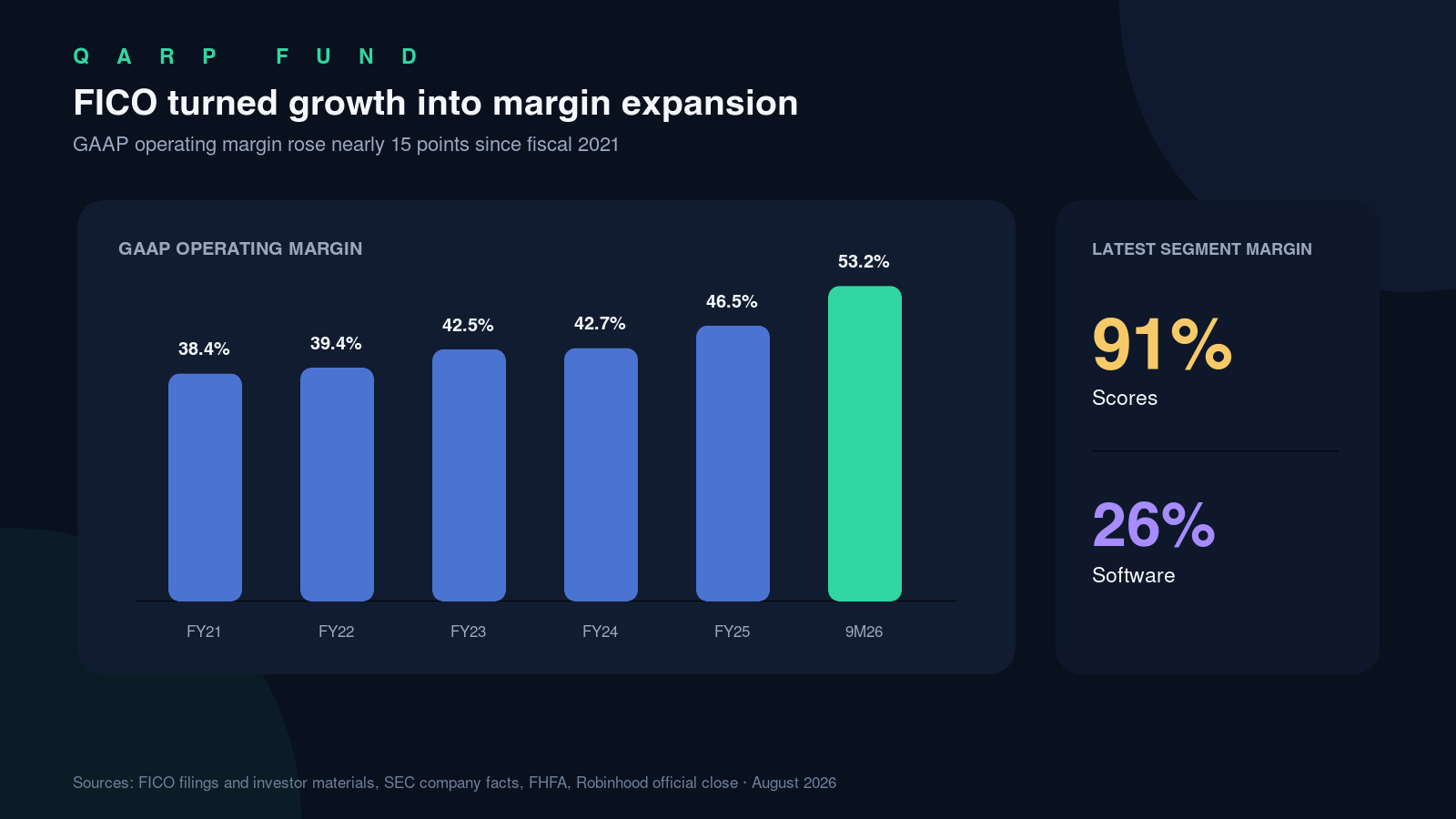
GAAP operating margin expanded from 38.4% in fiscal 2021 to 46.5% in fiscal 2025. Through the first nine months of fiscal 2026, it reached 53.2%.
FICO does not need factories, inventory, or a large physical distribution network to grow. The company spent only $28 million on capital expenditures during the first nine months of fiscal 2026 while producing $778 million of operating cash flow.
That is why revenue growth converts so efficiently into cash.
Scores growth is spectacular - and concentrated
Scores revenue grew 41% in the latest quarter. B2B Scores grew 49%, while mortgage-origination revenue grew 97%.
Management identified the main driver directly: a higher mortgage-origination score unit price.
This is the bull case in one sentence. FICO owns a tiny but essential input inside a very large financial transaction, and the price of that input can rise without materially changing the total cost of a mortgage.
The company is also changing distribution through its Mortgage Direct License Program. Its investor presentation lists three pricing options:
Classic FICO at $4.95 per score plus a $33 funded-loan fee
FICO Score 10T at $0.99 per score plus a $65 funded-loan fee
A $10 per-score model for Classic FICO or FICO Score 10T
FICO says signed resellers represent approximately 60% of U.S. mortgage volume, and it is engaged with resellers representing about 90%.
The direct model can remove credit-bureau markups, improve pricing transparency, and let FICO capture more of the economics.
It is also a defensive move.
The mortgage monopoly is becoming a competitive moat
The strongest bear argument is no longer theoretical.
FHFA and HUD are implementing VantageScore 4.0 and FICO Score 10T for mortgage underwriting. Fannie Mae and Freddie Mac are immediately accepting Vantage-scored loans from approved lenders.
For decades, FICO benefited from being the required standard. The market is moving toward lender choice.
That does not mean lenders will abandon FICO overnight. Credit models sit inside underwriting systems, securitization processes, risk policies, and historical performance databases. Switching has operational and model-risk costs.
FICO also argues that its models have known performance through full credit cycles and remain the industry standard across multiple lending categories.
But the moat has changed.
It is shifting from mandated exclusivity toward installed distribution, historical trust, predictive performance, and workflow integration.
That can still be a powerful moat. It is not the same moat investors valued at the stock’s peak.
The Software headline hides a real platform transition
Software revenue grew only 2% in the latest quarter. That looks disappointing beside Scores.
Underneath the headline:
Total Software ARR reached $816 million, up 10%
Platform ARR reached $413 million, up 62%
Platform revenue grew 66%
Platform dollar-based net retention reached 148%
Non-platform ARR declined 17%
The new platform is growing rapidly while legacy products shrink or migrate. Platform ARR exceeded non-platform ARR for the first time in Q3.
This is the classic problem with a successful transition: the new product can grow quickly while the old base masks the result.
The 148% platform retention rate is especially important. It means the same customer cohort expanded spending by nearly half over the year, before including new customers.
If platform growth remains strong after the legacy drag becomes smaller, Software could reaccelerate. If it does not, FICO remains increasingly dependent on Scores pricing.
Buybacks transformed the per-share story
FICO reduced shares outstanding from 27.568 million at fiscal year-end 2021 to 21.597 million in June 2026 - a 21.7% reduction.
That makes every dollar of earnings and free cash flow more valuable to each remaining share.
The pace accelerated dramatically:
Fiscal-2025 repurchases: $1.415 billion
First nine months of fiscal 2026: $3.046 billion
Q3 alone: approximately $1.96 billion
FICO repurchased 1.705 million shares in Q3 at an average price of $1,149. The August 14 close was about 5.5% below that price.
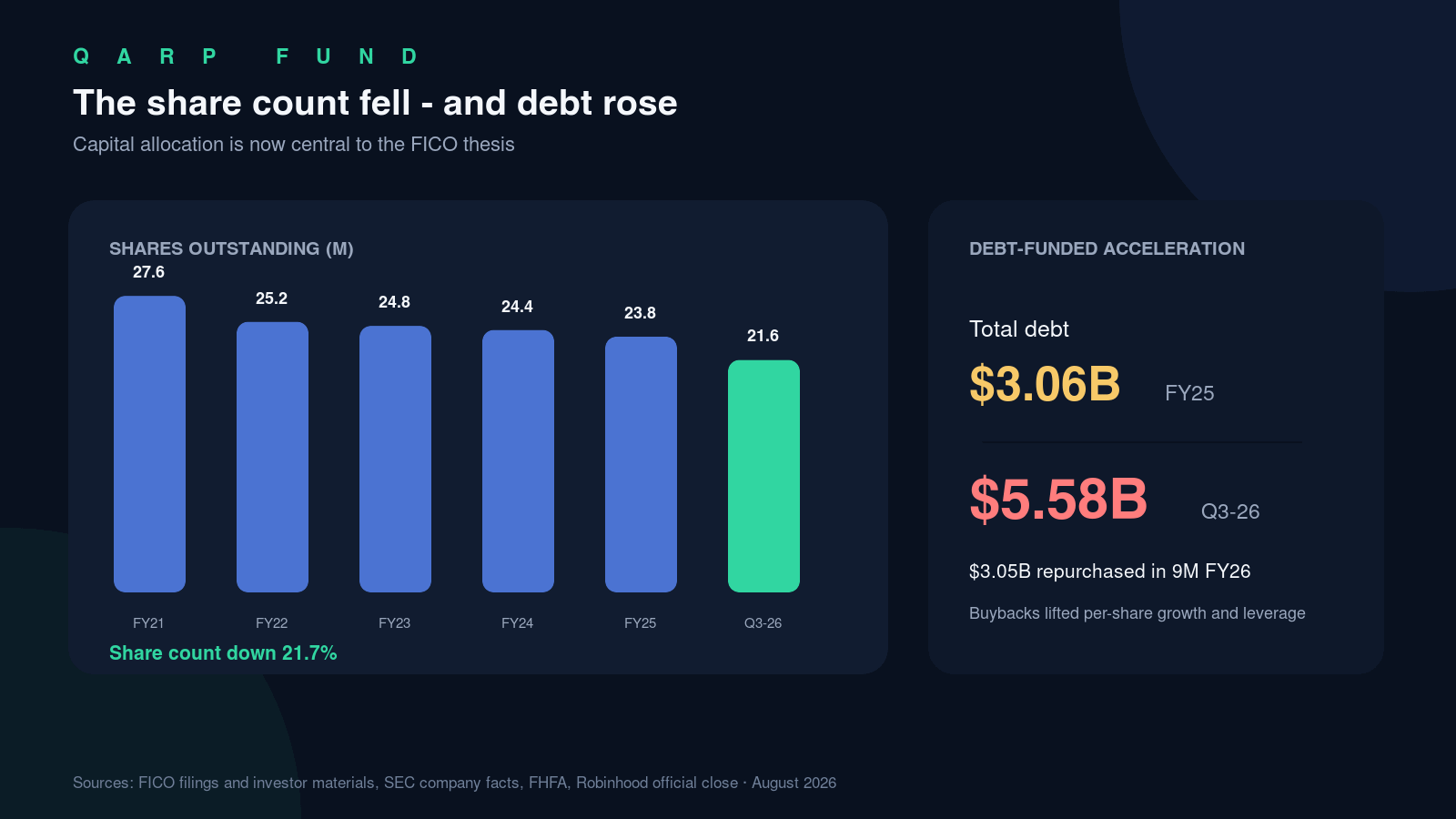
The uncomfortable part is how the company funded the acceleration.
Total debt rose from $3.06 billion in September 2025 to $5.58 billion in June 2026. After subtracting cash, net debt was approximately $5.33 billion.
FICO can support meaningful debt because its cash generation is exceptional. But debt-funded repurchases are not automatically value creation. They work only when the stock is purchased below intrinsic value and the balance sheet retains enough flexibility for a downturn or competitive shock.
The buyback is both a strength and a risk:
It accelerated per-share growth.
It signals management conviction.
It leaves less room for error if Scores pricing weakens.
The valuation finally looks reasonable - not obviously cheap
At the official August 14 close:
At the 52-week high, the same fiscal-2026 EPS guidance would imply more than 54x earnings. The current multiple is far less dependent on perfection.
But 24x free cash flow still assumes FICO will retain meaningful pricing power, defend mortgage adoption, and continue growing per-share cash flow.
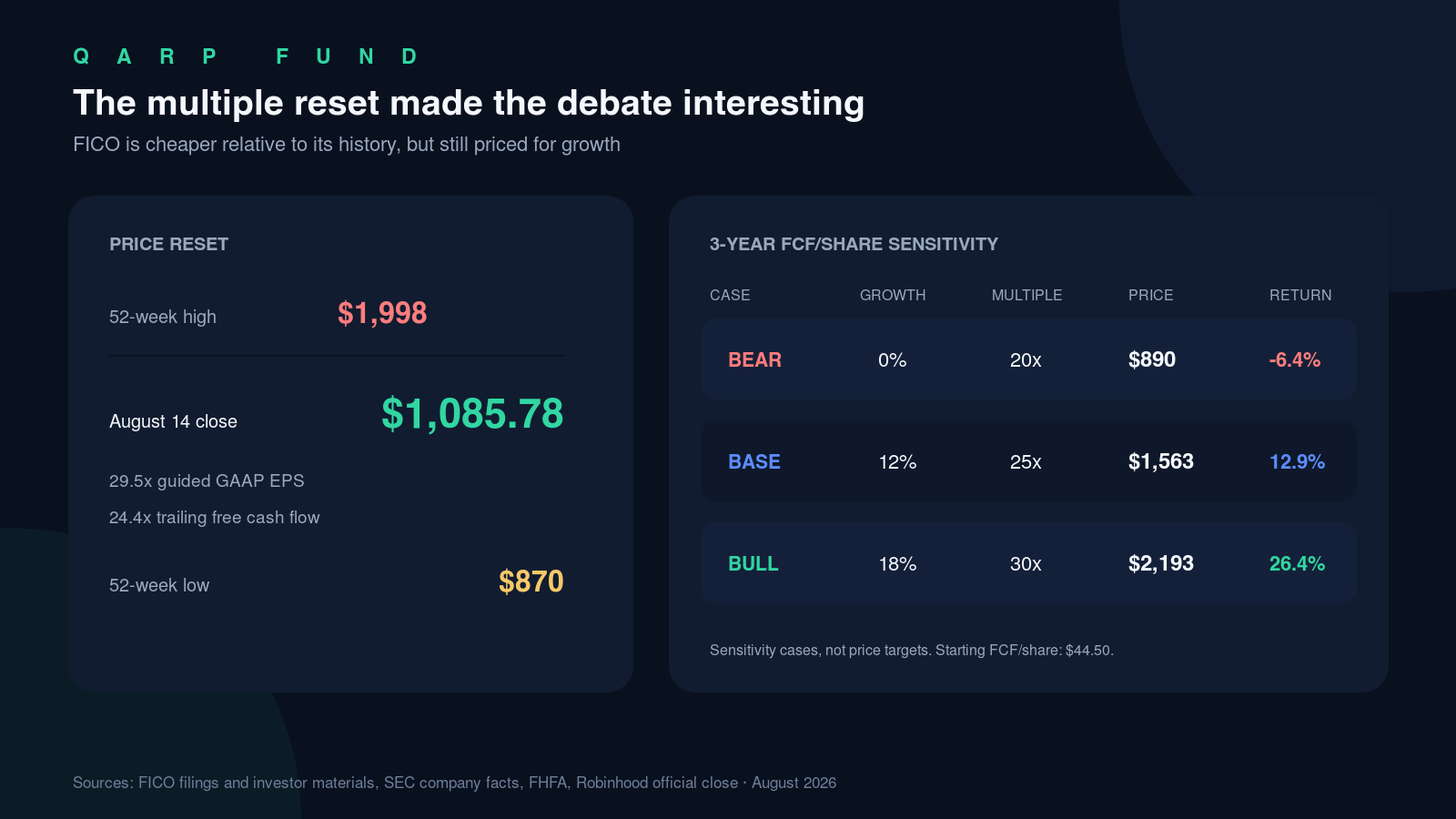
Using current trailing free cash flow of approximately $44.50 per share:
These are not price targets. They show what the current valuation requires.
The base case does not need a return to the old 50x-plus earnings multiple. It needs continued double-digit free-cash-flow-per-share growth and a premium, but not extreme, terminal multiple.
The bear case is also instructive. If cash flow stops growing and the market values it at 20x, the implied value is near $890 - close to the recent 52-week low.
What I would watch from here
Five metrics will determine whether the thesis works:
Mortgage Scores growth: How much comes from sustainable adoption versus price increases?
VantageScore usage: Approval matters less than actual funded-loan volume and lender conversion.
Platform ARR and retention: Platform ARR growth near 60% and retention near 150% would support a Software reacceleration thesis.
Scores margin: A sustained decline from the current 91% would signal competition or distribution costs are changing the economics.
Net leverage: Cash flow should begin absorbing the debt added for the accelerated repurchase.
My conclusion
FICO is a better investment candidate at $1,086 than it was near $2,000, even though the business is reporting stronger revenue, cash flow, and margins.
The market has removed much of the valuation excess. It has not removed the business risk.
I would describe the stock as reasonably priced for an exceptional business, not conventionally cheap.
The most compelling part of the thesis is the combination of:
27% guided revenue growth
$961 million of trailing free cash flow
A 53% GAAP operating margin through nine months
A share count that has fallen 22% since fiscal 2021
A valuation reset to roughly 24x free cash flow
The reason not to treat it as a no-brainer is equally clear:
Mortgage pricing drove much of the recent acceleration
VantageScore is now an approved competitor
Debt increased by more than $2.5 billion in nine months
Management bought stock above the current price
The old FICO thesis was a monopoly plus an unlimited multiple.
The new thesis is more interesting: a deeply embedded financial standard, still demonstrating extraordinary economics, now priced as if competition and capital allocation actually matter.
That is finally a debate worth having.
Disclosure: This article is for educational purposes and is not investment advice. The author may buy or sell securities discussed without notice. Financial data comes from FICO’s fiscal-2025 Form 10-K, Q3 fiscal-2026 earnings release and investor presentation, SEC company facts, FHFA, and Robinhood’s official August 14, 2026 close.