
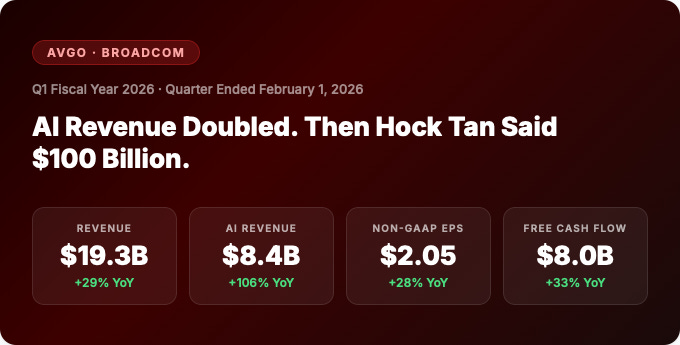
Broadcom reported fiscal Q1 2026 earnings after the bell on Wednesday, and the headline numbers were strong across the board. But the number Wall Street will be talking about isn't $19.3 billion in quarterly revenue. It's $100 billion — the AI revenue figure CEO Hock Tan said the company has "line of sight" to achieve by 2027.
The Numbers Were Clean
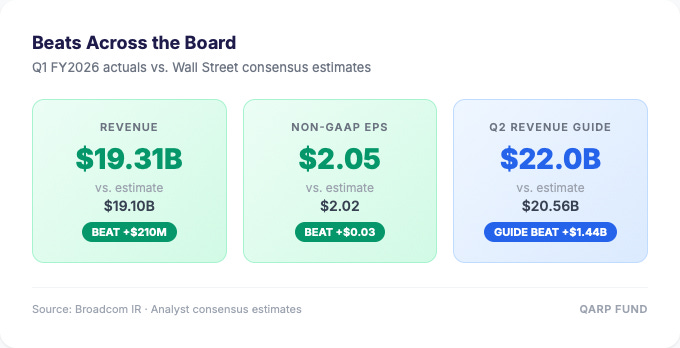
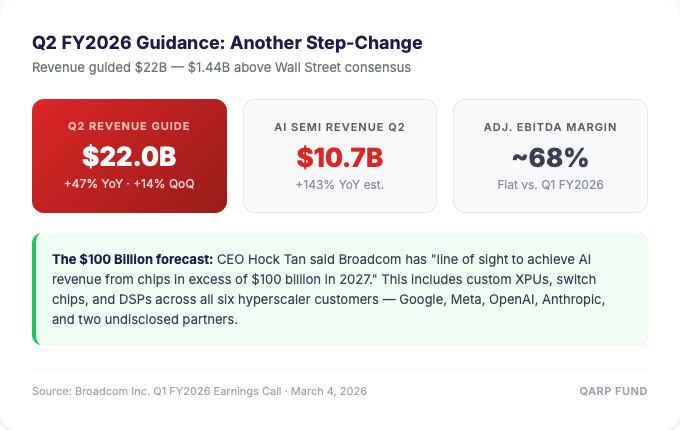
Broadcom beat on every metric that matters. Revenue came in at $19.31 billion, up 29% year-over-year, against a Wall Street consensus of $19.1 billion. Non-GAAP EPS of $2.05 topped the $2.02 estimate. But the real beat was in guidance: Q2 revenue guided to $22.0 billion versus the $20.56 billion consensus — a $1.44 billion upside surprise that sent the stock up ~5% in after-hours trading.
Revenue Has Been Compounding Steadily
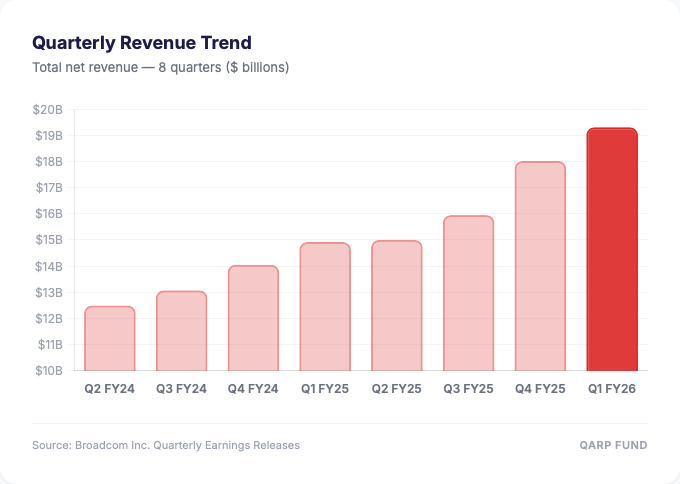
Broadcom's total revenue growth re-accelerated meaningfully this quarter. After several quarters in the 20–22% YoY range, Q1 FY2026 printed +29% — driven almost entirely by AI semiconductor demand outpacing the rest of the business. The trajectory heading into Q2's $22 billion guide suggests the growth rate itself is still climbing.
AI Revenue More Than Doubled
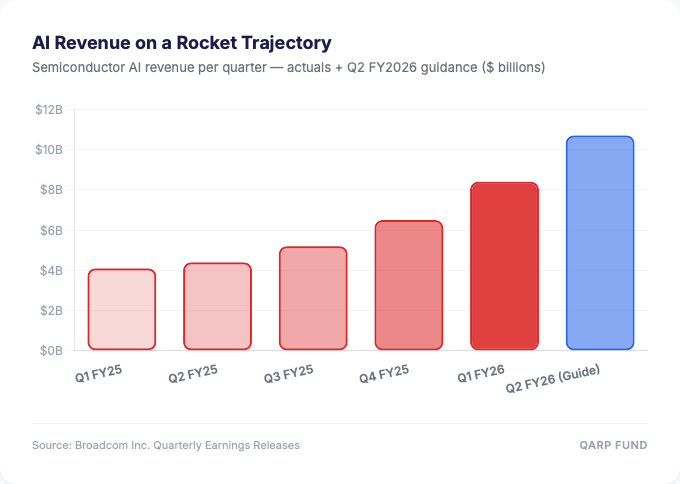
The standout number: AI semiconductor revenue hit $8.4 billion in Q1 FY2026, up 106% year-over-year. That's not a rounding error — AI revenue literally more than doubled. And Q2 guidance calls for $10.7 billion, implying roughly 143% YoY growth for the current quarter. The blue bar in the chart below represents Q2 guidance, not actuals — which makes it even more striking.
Two Very Different Business Segments
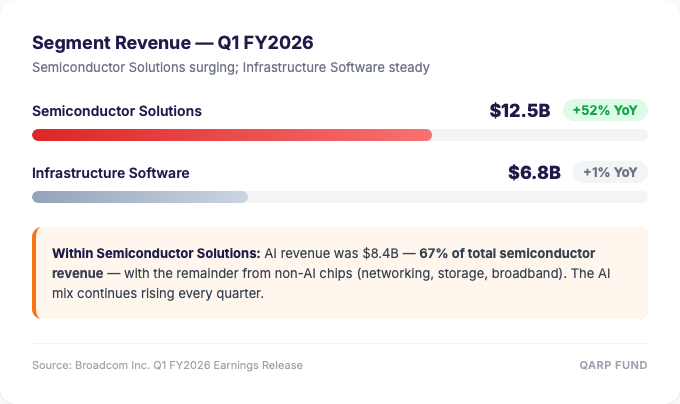
Broadcom's business has two legs: Semiconductor Solutions and Infrastructure Software. In Q1 FY2026, those two legs moved in completely opposite directions. Semiconductor Solutions grew 52% year-over-year to $12.5 billion, almost entirely driven by AI chip demand. Infrastructure Software — the legacy VMware business acquired in 2023 — grew just 1% to $6.8 billion. The strategy is playing out exactly as Hock Tan designed: use the software cash flow to fund the AI buildout.
The Q2 Guidance Is What Changes the Math
Guiding to $22 billion for Q2 — with AI semiconductor revenue expected at $10.7 billion — is the kind of forward guidance that forces analysts to rip up their models. Prior Wall Street estimates for full-year FY2026 were clustering around $72–75 billion. With Q1 at $19.3B and Q2 guided at $22B, that full-year number is almost certainly going higher. Adjusted EBITDA margins are expected to hold steady at ~68%, meaning every incremental revenue dollar is highly profitable.
What Wall Street Is Focused On Now
The $100 billion forecast is the most significant thing Hock Tan has ever said publicly about Broadcom's AI business. That's not a vague aspiration — it's a CEO with a track record of disciplined capital allocation making a specific directional claim about a specific revenue line. If AI revenue hits $100 billion in fiscal 2027, that's roughly five times what Broadcom generated in AI chips in all of FY2025. The math requires continued acceleration from all six hyperscaler customers, expanding silicon content per cluster, and Broadcom's Ethernet networking revenue growing to ~40% of total AI chip revenue. None of that is guaranteed. But the order book is suggesting it's on track.
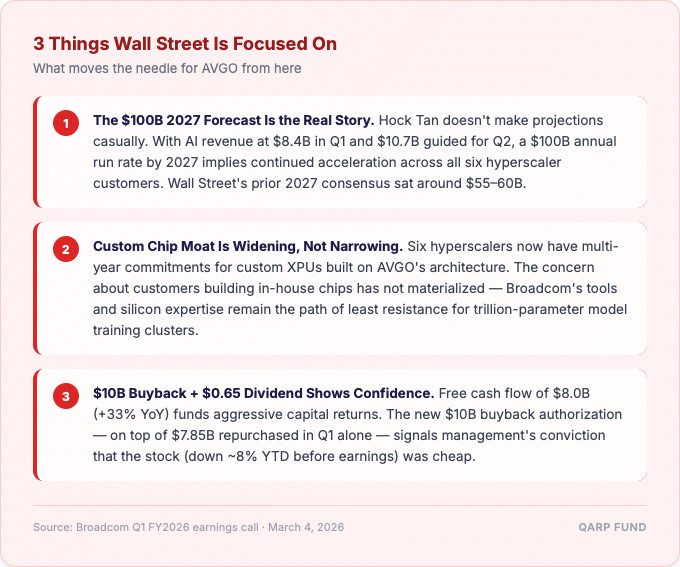
Broadcom reports next quarter in June. Between now and then, watch for any announcements from hyperscaler customers about their capex plans — those will be the leading indicator for whether the $100 billion 2027 forecast is tracking.